
When you start investing in the stock market, one of the first decisions you will face is whether to buy dividend stocks or growth stocks. Both can help you build wealth over time, but they work differently and may suit different financial goals.
Dividend stocks are companies that distribute part of their profits to shareholders, while growth stocks are companies that focus on expanding their businesses and increasing their value. Understanding the difference between dividend stocks and growth stocks can help you choose investments that match your income needs, risk tolerance, and long-term plans.
In this blog post, we will explain how both types of stocks work, their advantages and disadvantages, and how beginners can decide which strategy makes more sense. We will also look at practical examples to help you understand how each approach can contribute to building wealth.
What Are Dividend Stocks?
Dividend stocks are shares of companies that regularly distribute a portion of their earnings or accumulated profits to shareholders. These payments are called dividends, and they provide investors with a way to earn money from their investments without necessarily selling their shares.
For example, imagine you own 100 shares of a company that pays an annual dividend of ₦5 per share. You would receive ₦500 in dividends for that year, assuming the company pays the declared amount and you qualify for the payment.
Companies that pay dividends are often established businesses with relatively predictable cash flows and a history of generating profits. However, not every dividend-paying company is financially strong, and dividends are never guaranteed.
How Do Dividend Stocks Make You Money?
Dividend stocks can generate returns in two main ways, through dividend payments and increases in the share price. This means you can potentially earn income while also benefiting if the market value of your shares increases.
For example, suppose you invest ₦100,000 in a company with a dividend yield of 5% per year. If the company maintains its dividend, you could receive approximately ₦5,000 in annual dividend payments before any applicable taxes or charges.
You can either withdraw the dividends and use them as income or reinvest them to purchase more shares. Reinvesting dividends can help your investment grow over time because your additional shares may also qualify for future dividend payments.
Examples of Dividend-Paying Companies
In Nigeria, some companies with a history of paying dividends include GTCO, Zenith Bank, and Dangote Cement. Their dividend payments and yields can change from year to year, so investors should review recent financial statements and dividend announcements before investing.
Internationally, companies such as Coca-Cola, Johnson & Johnson, and Procter & Gamble are well-known examples of businesses that have historically paid dividends. Their established business models and dividend histories make them popular among investors seeking income, although past payments do not guarantee future dividends.
>>RELATED: How to Make Money With Dividend Stocks in 2026: A Beginner’s Guide
What Are Growth Stocks?
Growth stocks are shares of companies that investors expect to increase their revenue, earnings, or overall business value faster than the broader market. These companies often reinvest a significant portion of their profits into expansion instead of distributing them to shareholders as dividends.
For example, a technology company may use its profits to develop new products, enter additional markets, hire employees, or improve its infrastructure. The goal is to expand the business and potentially increase its share price over time.
Growth companies are often found in industries such as technology, healthcare, artificial intelligence, and consumer services. However, a company does not need to operate in a particular industry to qualify as a growth stock, and its future growth is never guaranteed.
How Do Growth Stocks Make You Money?
Growth stocks primarily generate investment returns through increases in their share prices. If the company performs well and investors become more confident in its prospects, demand for its shares may increase and push the market price higher.
Imagine you invest ₦100,000 in a growth company whose shares increase in value by 30% over a year. Your investment would then be worth ₦130,000, giving you a ₦30,000 gain before taxes and transaction costs if you sold at that price.
Unlike dividend investing, you generally do not receive regular cash payments simply for holding a growth stock. You usually realise your investment gain when you sell your shares, although the company may also introduce dividends later as its business matures.
Examples of Growth Stocks
Companies such as Amazon, Tesla, and Nvidia are commonly associated with growth investing because investors have historically valued them for their expansion opportunities and future earnings potential. Their share prices can experience significant increases, but they can also fall sharply when expectations change, or business performance disappoints.
It is important to understand that a popular company is not automatically a good investment at every price. Even a successful business can become an expensive stock if investors pay more than its future earnings justify.
Dividend Stocks vs Growth Stocks: Key Differences
Although both dividend stocks and growth stocks represent ownership in businesses, they differ in how investors typically expect to earn returns. Understanding these differences will help you decide which approach is more suitable for your investment goals.
1. How You Earn Returns
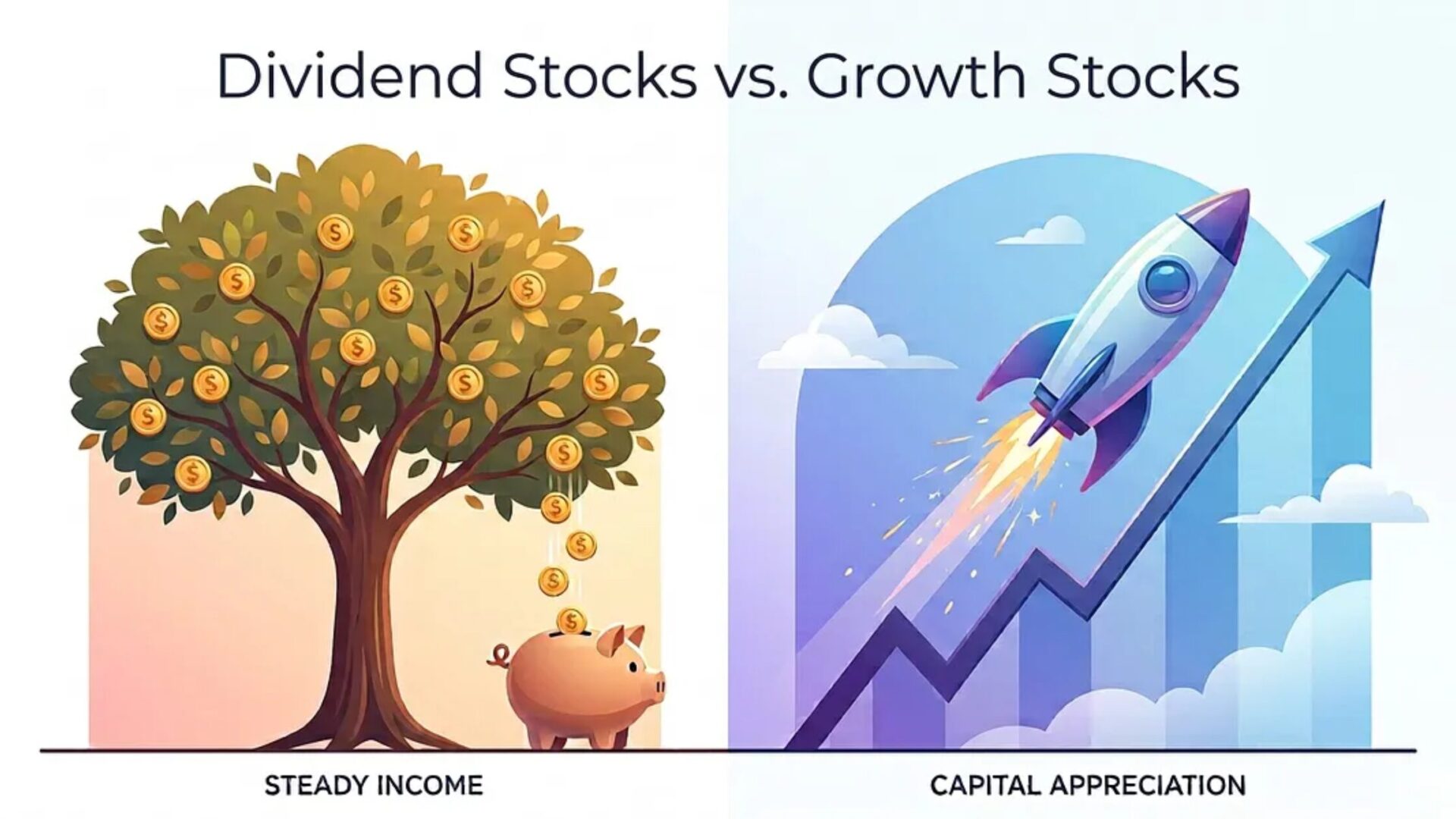
The main difference is how each investment strategy generates returns for shareholders. Dividend stocks provide the potential for regular cash payments, while growth stocks rely more heavily on increases in the market value of their shares.
This does not mean dividend stocks cannot increase in price or growth stocks cannot pay dividends. The distinction is that dividend investors generally place greater importance on income, while growth investors focus more on capital appreciation.
2. Income Generation
Dividend stocks can provide an additional income stream because companies may distribute cash to shareholders every quarter, twice a year, or annually. This can be useful for investors who want their portfolios to generate cash without having to sell shares.
Growth stocks generally do not provide the same level of regular income because many growth companies reinvest their profits into the business. Investors usually depend on share price appreciation to earn returns, which means they may need to sell some shares when they want to access their gains.
3. Potential for Capital Appreciation
Growth stocks are often purchased because investors expect the underlying companies to expand significantly over time. If the business performs well and its valuation increases, shareholders may benefit from substantial capital appreciation.
Dividend stocks can also appreciate in value, particularly when the companies continue to grow their earnings and maintain strong financial positions. However, investors who focus mainly on dividend income may place less emphasis on rapid share price growth.
4. Risk and Volatility
Growth stocks can be more volatile because their valuations often depend heavily on expectations about future performance. If a company fails to meet those expectations, its share price may fall considerably.
Dividend stocks are not automatically safe, but established dividend-paying companies may have more predictable earnings and cash flows. Their share prices can still decline, and a company experiencing financial difficulties may reduce or suspend its dividend.
5. Company Maturity
Dividend-paying companies are often more established businesses with relatively stable operations and fewer immediate opportunities to reinvest all their profits at attractive rates. They may choose to distribute some of their earnings to shareholders instead.
Growth companies are often still expanding and may prefer to reinvest available cash into new opportunities. However, company maturity is not a strict rule because some established businesses continue growing rapidly while some younger companies already pay dividends.
6. Investment Goals
Dividend stocks may appeal to investors who want to generate income from their portfolios, particularly those approaching retirement or looking for additional cash flow. They can also suit younger investors who prefer to reinvest dividends and build their holdings gradually.
Growth stocks may appeal to investors with longer investment horizons who are comfortable waiting for their investments to appreciate. They can be suitable for beginners who want to focus on building the value of their portfolios rather than receiving regular income.
Dividend Stocks vs Growth Stocks: Comparison Table
The table below summarises the major differences between dividend stocks and growth stocks.
| Feature | Dividend Stocks | Growth Stocks |
|---|---|---|
| Main return | Dividend income and share price appreciation | Mainly share price appreciation |
| Regular income | Potentially yes | Usually limited or none |
| Company focus | Often distributes some profits | Often reinvests profits |
| Investment goal | Income and long-term wealth | Long-term capital growth |
| Price volatility | Varies by company | Can be relatively high |
| Best suited for | Investors seeking income | Investors seeking capital appreciation |
| Main risk | Dividend cuts and business decline | Slow growth, high valuations and price declines |
Neither category guarantees better investment performance, and the quality of the individual company matters more than its label. A financially strong growth company may outperform a poorly managed dividend company, just as a reliable dividend business may be a better investment than an overpriced growth stock.
Which Is Better for Beginners: Dividend Stocks or Growth Stocks?
There is no universal answer because the better option depends on what you want your investments to achieve. However, understanding your financial goals and investment timeline can make the decision much easier.
When Dividend Stocks May Be Better
Dividend stocks may be a better starting point if you want your investments to generate cash payments over time. They can also help you understand how companies distribute profits and how shareholders benefit from owning a business.
For example, a beginner who invests ₦50,000 in dividend-paying companies may receive relatively small payments at first, depending on the dividend yield and number of shares owned. By consistently investing and reinvesting those payments, the investor can gradually increase the number of shares held and potentially grow future dividend income.
However, do not choose a stock simply because it offers a high dividend yield. A very high yield may indicate that the share price has fallen because investors are concerned about the company’s financial health or that the dividend may not be sustainable.
When Growth Stocks May Be Better
Growth stocks may be more suitable if your primary goal is to increase the value of your investment over a long period. This approach can make sense for beginners who do not need immediate investment income and are comfortable with fluctuations in the market.
For example, a 21-year-old investor with a 10-year investment horizon may prefer to invest in businesses with strong opportunities for revenue and earnings growth. Instead of relying on regular dividend payments, the investor can focus on companies that may become more valuable as their businesses expand.
However, having a long investment horizon does not mean you should ignore risk. You still need to evaluate the company’s financial performance, valuation, competitive position, and ability to deliver on its growth plans.
Can You Invest in Both Dividend Stocks and Growth Stocks?
Yes, you can invest in both dividend stocks and growth stocks as part of the same portfolio. This approach allows you to combine the potential income from dividend-paying companies with the capital appreciation opportunities offered by growth companies.
For example, imagine you have ₦100,000 available to invest and decide to allocate 60% to growth stocks and 40% to dividend stocks. You would invest ₦60,000 in growth companies and ₦40,000 in dividend-paying companies, giving your portfolio exposure to both strategies.
The allocation does not have to remain fixed because your financial goals, income, risk tolerance, and market conditions may change over time. You should also remember that owning several stocks does not automatically create a diversified portfolio if they all operate in the same industry or depend on similar economic conditions.
If you want to understand how to combine different investments, read our guide on How to Build an Investment Portfolio for Beginners. It explains how to spread your investments across different assets and manage risk more effectively.
How to Choose Between Dividend Stocks and Growth Stocks
Before investing, you should consider more than the possibility of receiving dividends or making a profit from share price increases. The following factors can help you choose a strategy that fits your financial situation.
1. Identify Your Investment Goal
Start by deciding what you want your investments to achieve. If you want to generate additional income, dividend stocks may deserve more attention, while growth stocks may be more appropriate if your main objective is long-term capital appreciation.
Your goals can also change as your financial situation develops. You might focus more on growth when you are younger and gradually increase your exposure to income-generating investments as you approach retirement.
2. Consider Your Investment Timeline
Your investment timeline refers to how long you intend to keep your money invested before needing it. A longer timeline may give you more opportunity to benefit from business growth and reinvested dividends, although it does not eliminate the risk of losing money.
If you need the money within a few months or a year, investing heavily in individual stocks may be unsuitable because their prices can fall unexpectedly. Money intended for short-term expenses is generally better kept in more suitable, lower-volatility options.
3. Understand Your Risk Tolerance
Risk tolerance describes how comfortable you are with the possibility of losing money or watching your investment value decline. Growth stocks can experience significant price swings, so you need to be comfortable with the possibility of temporary or even lasting losses.
Dividend stocks also carry risks, including dividend cuts and declining share prices. Choose companies whose business risks you understand rather than investing based only on their past performance or popularity.
4. Research the Company’s Financial Health
Before buying any stock, examine the company’s revenue, profitability, debt, cash flow, and competitive position. These factors can help you understand whether the business has the financial strength to maintain its operations and create value for shareholders.
For dividend stocks, pay particular attention to the company’s ability to generate enough cash to support its dividend payments. For growth stocks, examine whether revenue and earnings are expanding sustainably rather than relying entirely on optimistic forecasts.
5. Consider the Stock’s Valuation
A good company is not necessarily a good investment if its shares are too expensive relative to its financial performance and prospects. Valuation helps you assess whether the price you are paying is reasonable compared with the company’s earnings, assets, cash flow, and growth expectations.
For example, a company may have excellent growth prospects but still be a poor investment if its share price already reflects unrealistic expectations. Similarly, a dividend stock with an attractive yield may be overpriced or financially weak, so you should examine the full picture before investing.
Common Mistakes Beginners Should Avoid
1. Choosing a Stock Only Because of Its Dividend Yield
A high dividend yield can look attractive, especially when you are hoping to earn regular income from your investments. However, the yield may be unusually high because the share price has dropped, or the company may be paying dividends that it cannot sustain.
Always investigate the company’s earnings, cash flow, debt, and dividend history before investing. A sustainable dividend from a financially healthy business is generally more meaningful than an unusually high yield from a struggling company.
2. Assuming Growth Stocks Always Increase in Value
Growth stocks are associated with companies that have strong expansion opportunities, but that does not mean their share prices will always rise. A company can grow its revenue while its stock price falls because of high valuations, weak profitability, competition, or changing investor expectations.
Do not confuse a company’s growth potential with a guaranteed investment return. Research the business and consider whether its current share price reasonably reflects its prospects.
3. Ignoring Diversification
Investing all your money in one dividend stock or one growth company exposes you to the risks associated with that individual business. Even a company with a strong reputation can experience financial difficulties, management problems, or industry disruption.
Consider spreading your investments across different companies, sectors, and asset classes where appropriate. You can also explore diversified funds if you want exposure to several companies without selecting every stock individually.
4. Chasing Recent Performance
Beginners sometimes buy a stock simply because its price has increased significantly or because other investors are talking about it. This can lead to buying at an expensive valuation without understanding the company’s financial position.
Past performance does not guarantee future returns, whether you are investing in dividend stocks or growth stocks. Make decisions based on business fundamentals, valuation, and your investment goals rather than excitement or fear of missing out.
5. Forgetting About Taxes and Investment Costs
Dividend payments and stock transactions may involve taxes, brokerage fees, and other charges depending on the market and the investor’s circumstances. These costs can reduce the actual return you receive from your investments.
Before investing, understand the relevant charges and tax rules for the market where you are buying shares. This is particularly important if you invest in both Nigerian and international stocks.
Frequently Asked Questions
Yes, some growth companies pay dividends, although many choose to reinvest most of their profits into expanding their businesses. A company can also begin paying dividends as it matures and its cash flow becomes more predictable.
Yes, you can receive dividend payments while continuing to own your shares. However, the company must declare and pay a dividend, and the amount is not guaranteed.
Growth stocks can deliver substantial returns when their businesses expand successfully, but they can also experience significant losses. Actual performance depends on the company, the price you paid, the investment period, and market conditions.
Yes, combining both types of stocks can help you pursue income and capital appreciation within one portfolio. The right allocation depends on your financial goals, risk tolerance, and investment timeline.
The amount you need depends on the stock’s price, your brokerage platform, and its minimum investment requirements. Some platforms allow beginners to start with relatively small amounts, but you should also consider transaction fees and avoid investing money needed for essential expenses.
Conclusion
The choice between dividend stocks and growth stocks comes down to what you want your money to achieve. Dividend stocks can provide income and the opportunity to grow your investment through reinvested payments, while growth stocks offer the potential for capital appreciation as businesses expand.
You do not have to choose only one strategy, especially if you are investing for the long term. Take time to understand the companies you are buying, diversify your portfolio, and choose investments that match your financial goals and risk tolerance.
If you are ready to take the next step, read our guide on How To Start Investing With Little Money In 2026 to learn how to begin building your portfolio, even if you do not have a large amount of money to invest.